No EU law defines a sovereign AI avatar. Four published instruments decide a claim anyway: the SEAL scale, the Commission’s own award, Germany’s C3A criteria, and a proposed Act.

In short
When a vendor offers a sovereign AI avatar, there is no certificate to ask for. There is a five-level scale the Commission has used to screen its own bidders. There is a German criteria catalogue that turns that scale into testable requirements. And there is a proposed Act that would put four assurance levels into law. This page sets out each one and what a buyer can ask for.
This is the second of three articles on sovereign AI avatars. The first, What Is a Sovereign AI Avatar?, gives the definition and the three tests. The third, Sovereign AI Avatars and Biometric Data Under the EU AI Act, covers why an avatar’s camera and microphone make it a harder case. This one answers a narrower question. When a buyer asks whether an AI system is sovereign, which published EU instruments can the answer be measured against?
This article describes our reading of published law and guidance. It is not legal advice, and every institution should confirm its own position with its own counsel.
Is there an official EU definition of sovereign AI?
We have not found one. If you go looking for a legal definition of sovereign AI, or of sovereign cloud, in EU law, there is nothing to find.
The Digital Decade Policy Programme, Decision (EU) 2022/2481, uses the phrase digital sovereignty four times. It does not define it in its definitions article. Its formula is “digital sovereignty in an open manner”.[1] The Commission’s Joint Research Centre said in a 2025 policy brief that the concept “still lacks a clear, shared definition”. It called the picture “fragmented across stakeholders and contexts”.[2]
The European cloud certification scheme, EUCS, is often cited as though it settles this. It does not. ENISA, the EU cyber security agency, published it as a candidate scheme in December 2020, and it is still a candidate.[3] In January 2026 the Commission said work on it “is expected to resume”. It said the revised Cybersecurity Act and the Cloud and AI Development Act “will fill gaps related to sovereignty aspects”.[4] We have found no record of adoption since.
That Act is the first binding instrument we have identified. The Commission proposed it on 3 June 2026 as COM(2026) 502, one of the four key areas of its European Technological Sovereignty Package.[5][15] It is still a proposal. Section 05 sets out what it would do.
Four instruments, seven milestones, no definition
What exists on sovereignty in EU cloud and AI, in the order it arrived, and what is still open.
- Dec 2020EUCS candidate schemeENISA publishes the cloud certification scheme for consultation. Still a candidate.
- Dec 2022Digital Decade DecisionUses digital sovereignty four times. Defines twelve terms in Article 2. Sovereignty is not one of them.
- Oct 2025EU Cloud Sovereignty Framework v1.2.1Five SEAL levels, written as tender specifications for one Commission procedure.
- Apr 2026Commission awardSEAL-2 as the eligibility floor. Four contracts, up to 180 million euro over six years.
- Apr 2026BSI C3A v1.0Germany turns the framework into testable criteria. Not binding in itself.
- Jun 2026Cloud and AI Development ActCommission proposal. Four Union assurance levels, in law if adopted.
- Sep 2026EESC opinionThe Economic and Social Committee backs the Act by 212 votes to none. Parliament’s committees take up the file.
- NextThree open items, no dates setParliament’s committee vote on the Act. The Commission’s promised framework update. The BSI audit guide and German C3A edition.
No official scheme certifies a provider as sovereign, as far as we have found. Germany’s C3A criteria, in section 04, are the closest thing to an official yardstick. They are testable, and Germany’s federal cyber security office, the BSI, says the framework is “not binding in itself”.[11] The Commission’s SEAL scale, next, has been used to screen bidders in a real award, but it certifies nobody. So a sovereignty claim today is still a claim a vendor makes about itself. That is why the six questions in What Is a Sovereign AI Avatar? matter more than the label.
The five SEAL levels, zero to four
The most useful official vocabulary today is the EU Cloud Sovereignty Framework, version 1.2.1 of October 2025.[9] It grades a cloud service on five Sovereignty Effectiveness Assurance Levels, SEAL-0 to SEAL-4.
The framework is a tender document. In its own words it “defines Sovereignty Objectives relevant for the provision of Cloud services requested in this procedure”. A tender names a minimum SEAL for each objective, and bids below the minimum “will be rejected”. So it grades a service for one buyer. It does not certify a company.
The level names and descriptions below are the Commission’s own.
The seal fills as sovereignty rises, from empty at SEAL-0 to solid gold at SEAL-4. The outlined level, SEAL-2, is the floor the Commission set for its own bidders in April 2026.
-
SEAL-0 No Sovereignty
Service, technology or operations under exclusive control of non-EU third parties, governed entirely in non-EU jurisdictions.
-
SEAL-1 Jurisdictional Sovereignty
The tier that grades unenforceabilityEU law formally applies with limited practical enforceability. Service, technology or operations under exclusive control of non-EU third parties.
-
SEAL-2 Data Sovereignty
Commission eligibility floor, April 2026EU law applicable and enforceable, with material non-EU dependencies remaining. Service, technology or operations under indirect control of non-EU third parties.
-
SEAL-3 Digital Resilience
EU law applicable and enforceable, EU actors exercising meaningful but not full influence. Service, technology or operations under marginal control of non-EU third parties.
-
SEAL-4 Full Digital Sovereignty
Technology and operations under complete EU control, subject only to EU law, with no critical non-EU dependencies.
Read SEAL-1 again. The framework has a tier for arrangements where EU law formally applies but cannot practically be enforced. That drafting choice tells you something. The Commission’s drafters thought that gap worth grading.
One more line in the framework matters for an AI avatar. The framework applies the scale across eight sovereignty objectives, and the third is named Data and AI Sovereignty. One of its contributing factors is the “extent to which AI models and data pipelines are developed, trained, hosted, and governed under EU control”.[9] So the Commission’s own scale already asks where the model runs, not only where the data sits.
Ask a vendor which SEAL level it would claim, and what stops it claiming the next one up. The second half is where the useful answer is. It converts an adjective into a position on a published scale.
The 2026 EU sovereign cloud award: the scale is no longer theoretical
On 17 April 2026 the Commission announced contracts for sovereign cloud services for EU institutions, bodies, offices and agencies. Union entities can procure up to 180 million euro of them over six years. SEAL was the instrument used to decide who was eligible. In the Commission’s words, “for the providers to be considered eligible, they needed to reach SEAL-2 level”.[10]
The Commission awarded four contracts, “to ensure diversification and resilience”.[10]
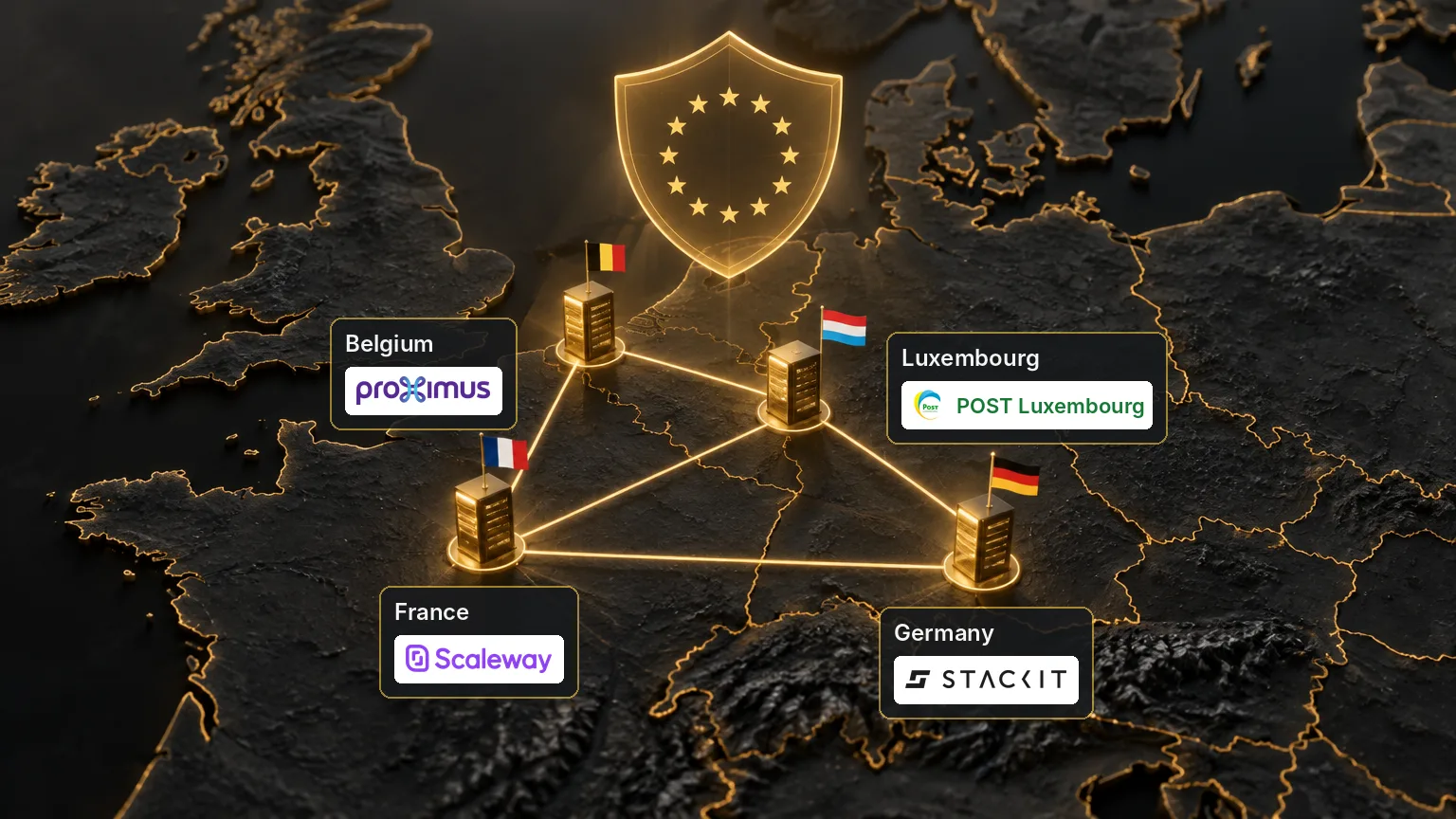
The four awards and their SEAL levels
As the Commission describes them.
Post Telecom
with OVHcloud and CleverCloud
STACKIT
of the Schwarz Group
Scaleway
of the Iliad Group
Proximus
with S3NS, Clarence and Mistral
The Commission notes in the same sentence that S3NS is a joint venture between Thales and Google Cloud.[10]
That matters for a reason that has nothing to do with who won. The question we suggest you put to a vendor is the same question the Commission put to its own bidders. And the answer has a floor. A service that could not reach SEAL-2 was not eligible to bid at all.
This was a procurement, not a certification. No provider on that list holds a sovereignty certificate, because no such certificate exists. A SEAL level in this award is an assessment of a specific service against specific requirements, by one buyer, at one point in time. A vendor who says it “is SEAL-3” without naming the service and the assessment has told you nothing you can check.
The award page also promised an updated framework “based on lessons learned from this tender”.[10] As at 22 October 2026 the Commission’s document page still shows version 1.2.1.
The market behind this is moving faster than the law. Gartner put European sovereign cloud infrastructure-as-a-service spending at 6.868 billion dollars in 2025. It forecast 12.587 billion in 2026, which it calls 83 percent growth, and 23.118 billion in 2027. At that point it expects Europe to surpass North America.[14]
On worldwide demand, its analyst Rene Buest said that “governments will remain the main buyers to meet digital sovereignty needs, followed by regulated industries and critical infrastructure organizations, such as energy and utilities and telecommunications”.
Treat a forecast as a forecast. The part worth noting is who is buying. A public buyer and a regulated one both have to write their reasons down. A written reason is a question you will be asked to answer.
BSI C3A: Germany has turned the scale into testable criteria
On 27 April 2026 Germany’s federal cyber security office, the BSI, published C3A, Criteria enabling Cloud Computing Autonomy, at version 1.0.[11] This is the development that changes the practical answer. It has had almost no coverage in English.
C3A takes the structure of the EU Cloud Sovereignty Framework and converts it into individual criteria a buyer can put to a provider. There are six domains: strategic, legal and jurisdictional, data, operational, supply chain and technology sovereignty. The BSI left security out on purpose. It already covers security through C5:2026, its cloud security attestation catalogue, and IT-Grundschutz, its baseline security method. C3A “presupposes that the cloud service provider meets the C5 criteria”.[11][13] Environmental sustainability is left out as outside the BSI’s remit.
Read the status carefully before anyone quotes it at you. The catalogue says “the C3A Framework is not binding in itself”. The BSI’s press release says the criteria have no regulatory effect.[11][12] No certification or attestation scheme is attached.
The BSI has said it will publish guidance on C3A audits, with an evidence process resembling C5 attestation. It also planned a German-language version for the end of June 2026. As at 22 October 2026 we have found neither.[12] What C3A is, is the most concrete published statement of what sovereignty means operationally.

Four criteria are worth reading in full if you buy or sell in this space.
| Criterion | What it requires |
|---|---|
| SOV-4-09-C Disconnection |
Cut every non-EU network connection without harming the service, including incoming updates, heartbeat signals and licence servers. Keep a documented disconnect process that is itself free of non-EU entities. Test it at least once a year and record the result. SOV-4-10 adds the reverse: reconnect, and install updates after a disconnect of up to 90 days. |
| SOV-4-01-C1 Personnel |
Three groups must be EU citizens with their main residence in the EU: everyone with access to the infrastructure, everyone in customer support, and everyone with management control. The C2 variant moves main residence to Germany. SOV-4-02-C1 adds that administrative access runs through EU access paths, with outside access restricted to narrow, monitored exceptions. |
| SOV-1-03-C1 Effective control |
The provider must be effectively controlled by one or more EU corporations and show customers how. Effective control covers direct or indirect influence on key strategic, financial or operational decisions by non-EU undertakings. SOV-1-04 adds 90 days notice to customers before any ownership or governance change that could affect this. |
| SOV-2-03-C1 State of defence |
If a member state declares a state of defence, the provider must let it take over what is needed to run the cloud, assets and personnel included, within the law. The guidance says this usually means documentation, source code and admin tools in a portable form. SOV-6-01 adds a source code backup in the EU, no older than 24 hours, with build scripts and deployment tools. |
The figure below maps all six C3A domains onto the three tests of a sovereign AI avatar from the first article. Those are legal control, data residency with a defined boundary, and operational control.
Where each C3A domain lands against the three tests
Our mapping, not the BSI’s. The criteria catalogue does not reference these tests.
SOV-1Strategic sovereigntySOV-2Legal and jurisdictional sovereignty
For example SOV-1-03, effective control by EU corporations, and SOV-2-03, the state of defence takeover.
SOV-3Data sovereignty
For example SOV-3-01, the customer must be able to check where its data is stored and processed.
SOV-4Operational sovereigntySOV-6Technology sovereignty
For example SOV-4-09, the annual disconnection test, and SOV-6-01, a source code backup held in the EU.
SOV-5Supply chain sovereignty
It cuts across all three rather than sitting inside one. That is a gap in our framing, not in the criteria.
BSI C3A version 1.0 of 27 April 2026. The criteria are voluntary.
On our reading, SOV-1 and SOV-2 are the legal control test. SOV-3 is data residency. SOV-4 and SOV-6 are operational control, and they are the hardest of the three to satisfy.
The practical change is that a buyer can now ask for a criterion number. A vendor who says the word sovereign and then cannot say whether it meets SOV-4-09 has answered the question.
The disconnection criterion is already being used as a public test. On 28 September 2026 AWS announced a test of its European Sovereign Cloud, scheduled for 24 October 2026. For several hours it was to run without a connection to the AWS Global Network backbone, with traffic rerouted over the public internet. AWS described the exercise as consistent with the objectives of the EU framework and the C3A criteria. It claimed no SEAL level and no criterion number. AWS said it would share an update with regulators and customers afterwards. As at 27 October 2026 it has not published a result.[16]
That is an announcement, and an announcement is not a result. It does show that a criterion written in April became a global cloud provider’s public exercise by autumn.
The Cloud and AI Development Act: four Union assurance levels
The Cloud and AI Development Act would put a scale into law. The Commission describes its aim as “introducing a single EU-wide assessment framework for cloud and AI sovereignty”.[5] The proposal text is more specific than that sentence suggests.
Article 16 establishes “a Union cloud computing sovereignty framework comprising four Union assurance levels”, with the criteria in Annex II.[6] The levels are numbered 1 to 4. They have no names. Level 1 rests on a self-assessment. Levels 2 to 4 need a third-party audit.
Recognition comes from the national authority of the member state where the provider is established, and the Commission keeps a central repository. An SME’s level 1 statement of conformity is recognised automatically across the Union.[6]
The procurement rule is the part a vendor will feel first. Under Article 30, public contracting authorities must require Union assurance level 1 as a minimum. Where a risk assessment finds public order relevance, they must procure only services recognised at levels 2, 3 or 4.[6] Annex II starts level 1 with the provider being established in the Union. Levels 2 to 4 require the infrastructure, assets and personnel of the provider and its subcontractors to be located in the Union. Levels 3 and 4 add that the personnel are Union citizens.[6]
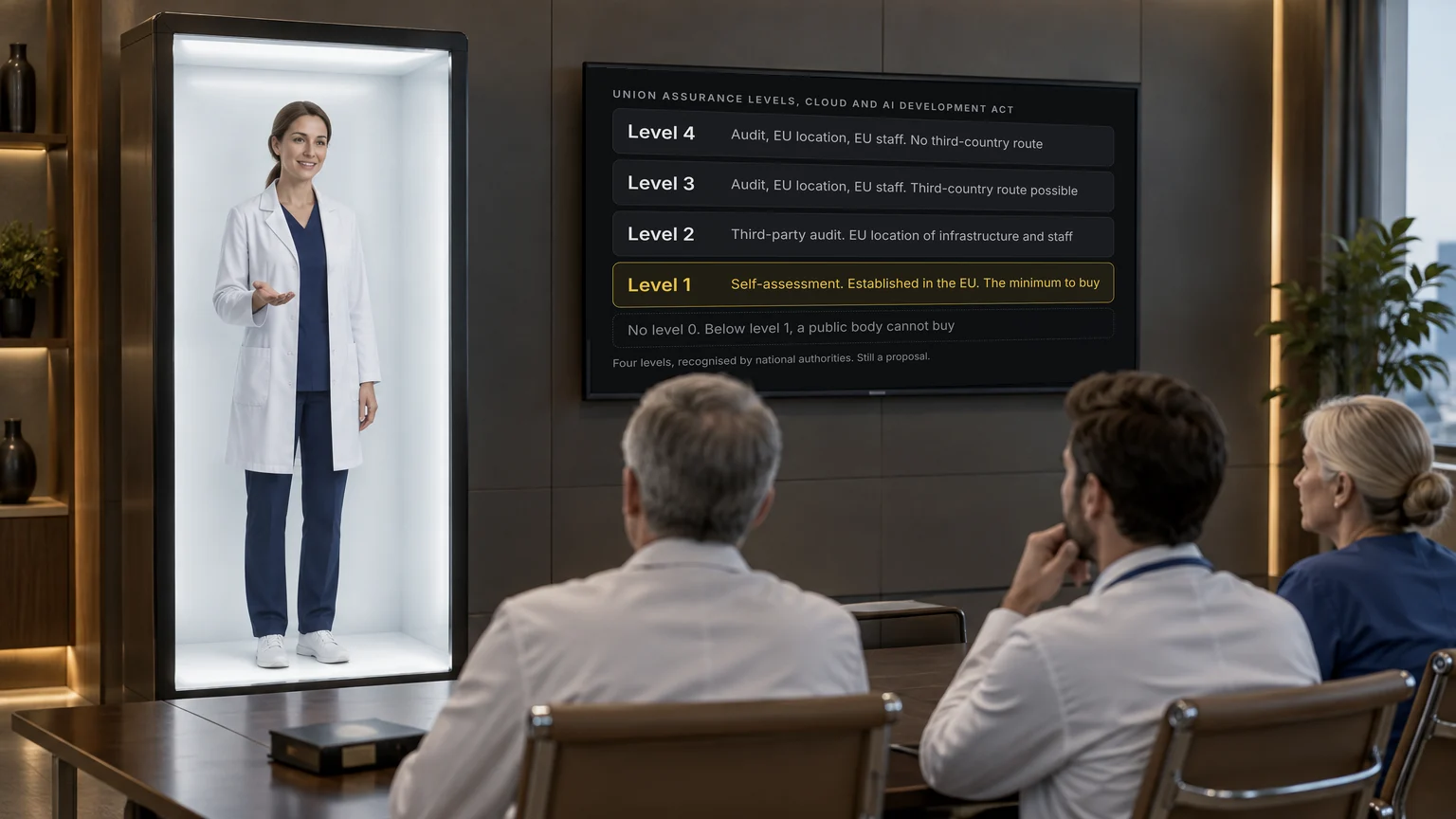
Two scales, not one
SEAL grades a bid in a Commission tender. The Act’s levels would be recognised by national authorities and required in public procurement. Gold marks the floor on each scale, the lowest level a public buyer accepts.
Five named levels. Grades a bid in one tender. Not a certification.
Four numbered levels. Recognised by national authorities. Still a proposal.
The two floors do not line up. The Commission’s floor is one step up its scale, the Act’s floor is the bottom of its scale. A SEAL-3 bid is not a level 3 service, and the proposal does not say how to translate one into the other.
Two more provisions are worth knowing. Article 18 allows a third country to be recognised, so that services it controls can qualify for level 3. The article does not open level 4 the same way, which is the practical line between the top two levels.[6] And recital 10, part of the Act’s explanatory preamble, draws a line that matters for an avatar platform. The cloud service definition “encompasses on-demand access to AI systems” hosted remotely. But “the AI system itself and its underlying model are excluded from the scope”.[6] So the Act would grade the hosting of an avatar, not the avatar.
Where it stands. Parliament’s industry committee, ITRE, and its internal market committee, IMCO, share the file. The lead MEPs were appointed in June 2026 and the referral was announced in plenary on 17 September 2026. The stage on the Parliament’s own procedure page is “awaiting committee decision”.[7]
The European Economic and Social Committee adopted its opinion on 23 September 2026 by 212 votes to none, with three abstentions.[8]
Industry is pushing back. A study commissioned by the trade association CCIA Europe put the ten-year cost at about 115 billion euro. The Commission’s upper estimate is 18 billion.[17] Read it as a lobbying position, which is what it is.
The same tests are reaching AI compute by another route. The EuroHPC call for up to seven AI gigafactories, large public AI compute centres, opened on 30 July 2026, with bids due 12 November 2026. It requires the coordinator to be incorporated in the Union and effectively controlled by EU entities or nationals. Core data must be stored and processed exclusively in the EU, and critical services must be run from EU territory by qualified personnel.[18] The vocabulary is the same as C3A’s. The instruments are converging even before the law is.
Where RAVATAR’s sovereign AI avatars fit
Read this section subject to the notice at the top of the page.
RAVATAR builds sovereign AI avatars and holograms for regulated environments such as hospitals. The criteria on this page were written for cloud services. They apply to the infrastructure an avatar runs on, and the Act’s recital 10 says so in terms. Here is how the platform answers them, domain by domain.
Strategic and legal sovereignty, SOV-1 and SOV-2
RAVATAR is incorporated and headquartered in Cyprus, an EU member state since 2004 and part of the euro area. It is owned by its founder, and customers contract with the Cyprus company. A registered head office in the EU is what SOV-1-02 asks for. Control that sits inside the EU, rather than with a non-EU undertaking, is what SOV-1-03 is testing for. Establishment in the Union is also where Annex II of the Act starts.
Data sovereignty, SOV-3
RAVATAR supports four deployment modes: on-premise, the institution’s private cloud, EU sovereign cloud, and global public cloud. In the on-premise and private cloud modes the platform deploys local models. Language, speech recognition and speech synthesis run inside the institution’s own environment, and no request to the model leaves it. That answers SOV-3-01 directly, because the institution can check where its data is stored and processed on its own infrastructure. It also answers the Commission’s Data and AI Sovereignty objective, which asks where the model is hosted and governed, not only the data. The strictest form is edge deployment. All inference runs on a single compact device with no cloud dependency, so an installation with no network connection at all is possible.
Operational and technology sovereignty, SOV-4 and SOV-6
The language model, speech recognition and speech synthesis layers are pluggable. The institution decides which components run and where. In the cloud modes it chooses the model in Genesis AI Avatar Studio or brings its own through its own API key. For a specific configuration we will set out every outbound channel, what it carries, and whether it can be disabled. That is the list the SOV-4-09 disconnection criterion asks for, and in the on-premise mode it is the institution’s own list to keep. The local deployment plan is described in our deployment guide.
Put a SEAL level or a criterion number to us for your own configuration, and we will answer in writing.
Measuring a vendor against these criteria?
Ask for a SEAL level and a criterion number rather than an adjective. We are glad to answer both for a specific configuration, in writing.
Start a conversationFrequently asked questions
Is there an official EU definition of sovereign AI?
We have not found one. EU law uses the phrase digital sovereignty without defining it, and the EUCS cloud certification scheme is still a candidate. The Cloud and AI Development Act, proposed in June 2026, would create four Union assurance levels in law. It is still a proposal. The closest official yardstick today is Germany’s C3A criteria of April 2026, which are testable and not binding.
What are the SEAL levels in the EU Cloud Sovereignty Framework?
Five Sovereignty Effectiveness Assurance Levels, SEAL-0 to SEAL-4, in the Commission’s framework of October 2025. SEAL-0 is no sovereignty. SEAL-1 is EU law formally applying with limited practical enforceability. SEAL-2 is EU law enforceable with material non-EU dependencies. SEAL-3 is meaningful but not full EU influence. SEAL-4 is complete EU control with no critical non-EU dependencies.
Is a SEAL level a certification?
No. SEAL grades a specific service against the requirements of one tender, by one buyer, at one point in time. In April 2026 the Commission used it to screen bidders for its own sovereign cloud contracts, with SEAL-2 as the floor. No provider holds a sovereignty certificate, because no such certificate exists.
What is BSI C3A?
C3A, Criteria enabling Cloud Computing Autonomy, is a criteria catalogue published by Germany’s Federal Office for Information Security on 27 April 2026. It converts the EU Cloud Sovereignty Framework into testable requirements across six domains, including an annual disconnection test and EU-only personnel. The BSI says the framework is not binding in itself, and no certification is attached yet.
How do the Cloud and AI Development Act’s levels relate to SEAL?
They are different scales. SEAL has five named levels and was written for one Commission procurement. The Act proposes four numbered Union assurance levels, recognised by national authorities, with level 1 as the minimum for public procurement. The proposal does not say how to translate one into the other, so do not convert between them.
Do these cloud criteria apply to a sovereign AI avatar?
Yes, to the infrastructure it runs on. SEAL and C3A were written for cloud services. The Act’s recital 10 says the hosting of an AI system is in scope while the AI system itself is not. A buyer can ask an avatar vendor which SEAL level it would claim, and whether it meets a named C3A criterion. That is exactly what it would ask a cloud provider.
Sources
Every legal statement in this article is traceable to one of these. Where a source carries a caveat, the caveat is reproduced in the text.
- Decision (EU) 2022/2481 establishing the Digital Decade Policy Programme 2030. Uses digital sovereignty in an open manner, in recitals and Article 3(1)(c), without defining it in Article 2. eur-lex.europa.eu
- European Commission Joint Research Centre, Open but Not Powerless: Towards a Common Understanding of EU Digital Sovereignty, Science for Policy Brief, JRC144908, 2025. publications.jrc.ec.europa.eu
- ENISA, candidate European Cybersecurity Certification Scheme for Cloud Services (EUCS), published for consultation 22 December 2020. enisa.europa.eu
- European Commission, Cybersecurity Package questions and answers, last updated 20 January 2026, question on EUCS. digital-strategy.ec.europa.eu
- European Commission, Proposal for a Cloud and AI Development Act, library page of 3 June 2026, source for the quoted aim. digital-strategy.ec.europa.eu
- European Commission, COM(2026) 502, Proposal for a Regulation establishing a framework of measures for strengthening Europe’s cloud and AI ecosystem (Cloud and AI Development Act), 3 June 2026, Recitals 10 and 51, Articles 16 to 22 and 30, and Annex II. Proposal text and annexes
- European Parliament, Legislative Observatory, procedure file 2026/0138(COD), committee assignment, rapporteurs and stage as at 22 October 2026. oeil.europarl.europa.eu
- Council of the European Union, cover note 13682/26 of 28 September 2026 transmitting the European Economic and Social Committee opinion INT/1126 on the Cloud and AI Development Act, adopted 23 September 2026. data.consilium.europa.eu
- European Commission, Cloud Sovereignty Framework, version 1.2.1, October 2025, sections 1, 3 and 4, and sovereignty objective SOV-3, Data and AI Sovereignty. commission.europa.eu
- European Commission, Commission advances cloud sovereignty through strategic procurement, 17 April 2026. Source for the ceiling, the SEAL-2 floor, the four awards, the S3NS note and the promised framework update. commission.europa.eu
- BSI, Criteria enabling Cloud Computing Autonomy (C3A), version 1.0 of 27 April 2026, sections 1.1, 1.2 and 1.4 and criteria SOV-1-03, SOV-1-04, SOV-2-03, SOV-3-01, SOV-4-01, SOV-4-02, SOV-4-09, SOV-4-10 and SOV-6-01. bsi.bund.de, direct PDF and landing page
- BSI, press release of 27 April 2026 announcing C3A, in German. Source for the criteria having no regulatory effect, the planned audit guidance and the planned German version. bsi.bund.de
- BSI, Cloud Computing Compliance Criteria Catalogue C5:2026, the edition C3A presupposes, revised in content and structure in line with the EUCS. bsi.bund.de
- Gartner, Gartner Says Worldwide Sovereign Cloud IaaS Spending Will Total $80 Billion in 2026, press release of 9 February 2026. Source for the European figures and the Rene Buest quotation. gartner.com
- European Commission, Strengthening Europe’s tech sovereignty, news of 3 June 2026 on the European Technological Sovereignty Package. commission.europa.eu
- AWS Security Blog, AWS European Sovereign Cloud: demonstrating an independent operation, 28 September 2026. An announcement of the 24 October 2026 exercise, not a report of its result. aws.amazon.com
- CCIA Europe, EU cloud sovereignty carries hidden 115 billion euro price tag, 13 October 2026, reporting an ECIPE study commissioned by the association. ccianet.org
- EuroHPC Joint Undertaking, EuroHPC JU launches AI Gigafactories call, 30 July 2026, and the call’s tender specifications, sections 3 and 7, on EU incorporation, effective control, data processing in the EU and critical services run from EU territory. eurohpc-ju.europa.eu