Ptosis Evaluation Questionnaire
What a ptosis evaluation questionnaire asks, with sample questions on the drooping eyelid, daily vision, and past treatment.
A ptosis evaluation questionnaire records how long the eyelid has been drooping, its effect on daily vision, past treatment, and health before an eyelid visit. The questions on this page are a typical set built from an eyelid surgery practice's intake form and an eye history questionnaire.

Ptosis evaluation questionnaire, handled by the AI Doctor avatar
AI Doctor, a real-time AI healthcare assistant avatar, asks the questions on a ptosis evaluation questionnaire in the patient's own language, strictly following the practice's instructions.
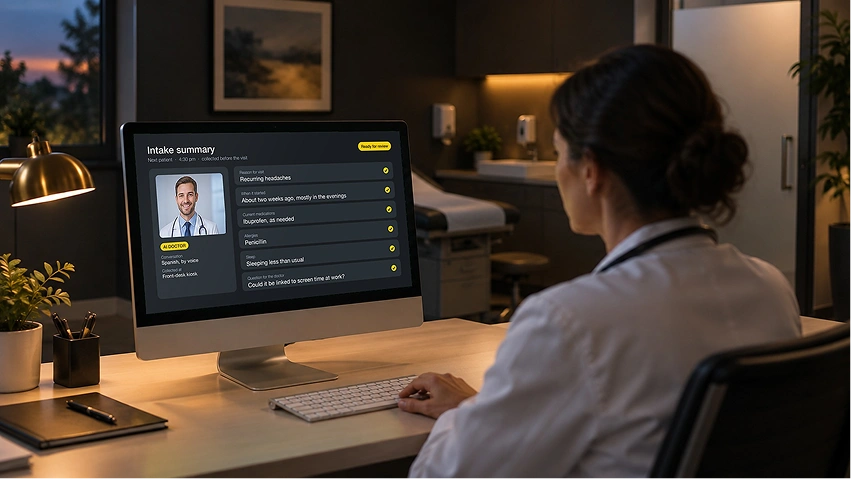
- Intake before the visit. Patients answer online before they arrive, or at a kiosk when they check in.
- Answers ready for the clinician. Clinicians see what the patient said before the visit starts.
- Less workload at the front desk. Staff spend less time handing out forms and entering answers by hand.
- Key details at a glance. The care team sees what matters up front and decides who needs attention first.
The form becomes a natural conversation: patients answer by talking, in their own words. AI Doctor is an information and patient-assistance interface. It collects answers for the care team to review. It doesn't diagnose, triage, or give treatment advice.
Sample ptosis evaluation questionnaire questions
Typical questions, written out so you can see the level of detail. Every practice words its own form differently.
- Do you have a drooping eyelid?Eyelid concern
- How long has the eyelid been drooping?Eyelid concern
- Do you have visual difficulty when driving?Daily vision
- Do you currently wear glasses?Daily vision
- Have you had eyelid surgery before?Past treatment
- What have you tried for this concern so far?Past treatment
- Do you wear contact lenses?Eye history
- Do your eyes feel dry or irritated?Eye history
- Do you have thyroid disease or diabetes?Medical history
- Do you have high blood pressure or heart disease?Medical history
- Do you take aspirin or ibuprofen regularly?Medications
- Which vitamins or herbal supplements do you take?Medications
These are examples to read, not a form to fill in.
Ptosis evaluation questionnaire: FAQ
What does a ptosis evaluation questionnaire ask?
The sample questions on this page are built from an eyelid surgery practice's intake form and SUNY Downstate's eye history questionnaire. This page groups them into six areas: eyelid concern, daily vision, past treatment, eye history, medical history, and medications.
Who fills in a ptosis evaluation questionnaire, and when?
The patient, before an eyelid consultation. In the eyelid surgery practice's packet, the questions on concerns and past treatment sit inside the new patient forms.
Does it ask about earlier eyelid surgery?
Yes. The eyelid surgery practice's form asks about previous cosmetic or surgical procedures, the year, the physician, and whether the patient was satisfied.
Does it ask about medicines?
The eyelid surgery practice's form asks about aspirin, ibuprofen, vitamins, herbal supplements, and hormone treatment. The avatar records the answers and gives no advice on them.
Does it ask about general health?
Yes. The eyelid surgery practice's form lists conditions such as thyroid disease, diabetes, high blood pressure, and heart disease.
What happens after the ptosis evaluation questionnaire is completed?
The practice's team reviews the answers before the eyelid exam. AI Doctor gathers them and leaves the assessment to the clinician.
Does AI Doctor give medical advice?
No. It collects information for the care team. It doesn't diagnose, triage, or recommend treatment.
Can patient answers stay on our own servers?
Yes. RAVATAR offers on-prem deployment: the platform can run inside your own perimeter, so patient answers stay there. RAVATAR complies with GDPR and the EU AI Act.
Set up your AI Doctor in Genesis AI Avatar Studio
Genesis AI Avatar Studio is where you set up, test, and publish AI avatars for your website, mobile app, or Holobox. No coding or technical skills needed.
- 01Choose the AI Doctor avatar.
- 02Add your practice's FAQs and visit information.
- 03Talk to it, then publish it.